This blog is an updated equivalent to a journal where records, pictures and comments on my assignments are to be shared with my peers, professor, and the world.
Video Of Dmitry Morozov's Vtol Project
(Courtesy: vtol.cc)
For my art in the news presentation I chose Dmitry
Morozov's Vtol project. Morozov is a Russian media-artist, musician
and engineer of strange-sounding mechanisms. His Silk installation,
in particular, was the focus of my presentation as it was related to music,
technology, and art. This piece is unique in that it autonomously makes music
using realtime fluctuations in litecoins and bitcoins connected to an Arduino
platform, sound systems, servo motors, guitar rails and a tuning mechanism. The
sounds vary depending on the unfalsifiability, immateriality, decentralization
and transparency of values.
"This piece explores how new technologies and
progress in such areas of knowledge as cryptography, mathematics, computer
science influence the financial system, inevitably changing the social
structure of the society", says Morozov.
The Silk installation was inspired by the
decentralization of existing currencies and the formation of a new unit of
exchange independent from political and geographical limitations. Currently the
piece is in Moscow and with each passing day change from the previous as does
the data it is responding to. Personally, I have not seen anything like this
before and was interested in sharing it because of how many discussions I have
had involving bitcoin over the past 4 years. It would be interesting to see how
the piece would react if the data were to reach the furthest extremes, worth
nothing and highly valued.
Below are pictures of the installation courtesy of Morozov's website:
Walter Benjamin, author, philosopher and cultural critic shown above (Courtesy: http://image.slidesharecdn.com)
Walter Benjamin's essay, The work of Art in the Age of Mechanical Reproduction brings attention to technological innovation and its impact on art. He uses art forms such as photographic negatives, lithography, and copperplate etching to describe how imitation has become more prevalent over the years. Stemming from mass production, curiosity, greed and self-interest, replication have always existed.
Benjamin argues that in principle, all works of art are able to be replicated. With many objects, structures, paintings or drawings, this is perhaps true, however, there are exceptions to this principle. Many pictures are considered works of art, featuring a specific time or event that transpired. In the example of a volcanic eruption, an event that occurs very rarely, it would be difficult for someone to reproduce a picture that someone took on a specific day, time, angle, lighting, etc. Even if the imitator managed to meet all the same criteria, there is such a minute statistical chance that someone would be able to get an identical picture. In the sense that someone could digitally scan the picture or use a negative and "replicate" it, is a possibility but is still a challenge to physically recreate. There are many forms of art, some easier to imitate than others and some not. In my opinion, performance art is not replicable. It can be imitated but not 100% replicated. Stage performers can practice and rehearse their routine as frequently as possible yet will not be able to perform the same time with consistency. Each interaction with other performers, the physical condition of the performer at the time, mood, and attention to detail are all contributing factors that make replication almost impossible. Overall, my take on the matter leaves me to believe that Walter Benjamin is wrong in stating all works of are replicable. There are certain forms of art that are unique in that they are not replicable by the nature of their appearance, circumstances, or properties. Benjamin, Walter. "The Work of Art in the Age of Mechanical Reproduction." Modern Art and Modernism. Auckland, N.Z.: PhotoForum, 2007. 218-20. Print.
Above is a depiction of what a Minstrel show performer would generally look like
(Courtesy: sideshowworld.com)
Today in class we watched Blacks on Vaudeville, a documentary on Vaudeville displaying its history and its correlation with minstrel shows. Minstrel shows, the poorly reenacted representation of how Black Americans, slaves, or "Negroes" entertained themselves during this time period. Beginning in 1843 and lasting till the mid-20th century, minstrel shows featuring musical and dance performances for crowds all over America (Minstrel Show, 2016).
Personally, I do not care for Vaudeville or minstrel shows either. As part of history I recognize minstrel shows as a point in Vaudeville's evolution, however, I cannot sit through a viewing without utter dismay. The shows reflect a point in time in which discrimination was very commended, with the specific goal of dehumanizing the Black American people.
The documentary highlighted the shows and its rising popularity in the 1840's. Before watching this segment, I had no idea that there were actually Black American minstrel performers. I always had the impression that it was a Caucasian person with black face, generating stereotypical propaganda to an all Caucasian crowd. To my surprise, I was wrong. Apparently the minstrel shows, featured some willing Black American participants, attendees and supporters. Understandably, for Black Americans at the time the wage was probably better than most paid positions, treatment was bearable, as well as the chance to perform on stage was rare. Some of these performers even used their talent, skills, and resistance to stereotyping to gain popularity amongst their community. As mentioned in the documentary, the Nicholas brothers are revered for doing just that.
The first minstrel performer to receive national recognition and have their performance considered that of a human was Bert Williams. In the documentary a frame shot is paused, displaying a quote by George Washington Carver, best known for developing a variety of uses for crops such as peanuts, then leading numerous speaking engagements as a symbol of African-American achievement (McMurry, 1991). The quote reads, "Bert Williams has done more for the race than I have. He's smiled his way into people's hearts" (Crazybluezzdaddy, 2012). As of 1910 he was the most respected comedians on the American stage and was the first Black American to be admired by people of all races. Overall, there is a collection of good stories of Black American performers leaving their impact on Vaudeville's history, however, those that were not featured are to be even more considered. With its racist and stereotypical motif, it is no wonder why minstrel shows began to disappear just as the civil rights movement started.
Below is a portion of the documentary by PBS, originally aired on November 26, 1997.
"minstrel show". Encyclopedia Britannica.Encyclopedia Britanncia Online. Encyclopedia Britannica Inc., 2016. Web. 24 Feb. 2016
McMurry, Linda O. "George Washington Carver." History.com. A&E Television Networks, 1991. Web. 24 Feb. 2016.
Crazybluezzdaddy. "Blacks and Vaudeville: PBS Documentary." YouTube. YouTube, 29 May 2012. Web. 24 Feb. 2016.
Above, the cast of The Pirates of Penzance, 1983. Directed by Wilford Leach
(Courtesy: blogspot.com)
As assigned I created a video game based on an opera created before the year 1920. For the video I decided to choose the opera The Pirates of Penzance. The story follows a pirate apprentice, who wishes to rid himself of the pirate life now that he has reached the age of 21, the end of his contractual service. After it is revealed that he was born on a leap year and technically has 5 birthdays, the loyal pirate must find a way to please his crew but also win the love of his life, Mabel.
In short, my game would fall under the open world category and follow protagonist Fredric, as he ventures through Penzance Bay seeking to gain freedom from the life of a pirate. Throughout the campaign gameplay, characters from the opera are featured, side missions are available, and interactions which lead to greater character development are present.
The following images are a few screenshots of my paper. Overall, the film adaptation was difficult to watch, but the project was thought provoking as it allowed for unlimited creativity.
Tuesday's class involving paper airplanes was a great learning experience. It bridged the gap between 2D material and 3D models. It was curiosity that lead man to reach new heights and discover flight. Pioneers in China around 400 B.C., discovered the earliest form of flight with the invention of the kite (Shaw, 2014). Since this event, many other innovators and inventors went on to create their own flying mechanisms bringing them closer to the modern invention of the airbus. Most notably are Leonardo da Vinci, The Wright Brothers, and Alberto Santos-Dumont (JACO, 2016).
Before class it was each student's responsibility to act as innovators and inventors, using previous paper airplane designs to craft our very own models. There were no restrictions to what a student could craft, leaving creativity as well as imagination unhindered. Personally, it was a far greater outcome without the existence of guidelines or a criterium. As for my model, I searched many sources which had claimed to feature the best design, however, I ended up testing the few that I thought to be promising but reverted to a model that had worked for me in the past. Many of the other models caught my attention with colorful and rounded designs.
The competition between the class revealed that some had the most creative, shortest, longest, and most aerodynamic designs. I personally liked moving out to the parking garage giving each student the chance to demonstrate how aerodynamic their paper plane was. During this event, it was Joey and Dozer's airplanes that impressed me the most. Their models had been crafted in a way such that the wind carried them a great distance with little to no resistance. My plane on the other hand did not do so well outside despite winning the longest distance indoors. Overall, this was a powerful activity that brought out creativity and competition amongst myself and the other students.
Shaw, Robert J., Dr. "History of Flight." History of Flight. NASA, 12 June 2014. Web. 15 Feb. 2016
JACO Aerospace. "History of Aviation: Aircrafts Through Time. " www.e-aircraftsupply.com. Jaco Aerospace, n.d. Web. 15 Feb. 2016.
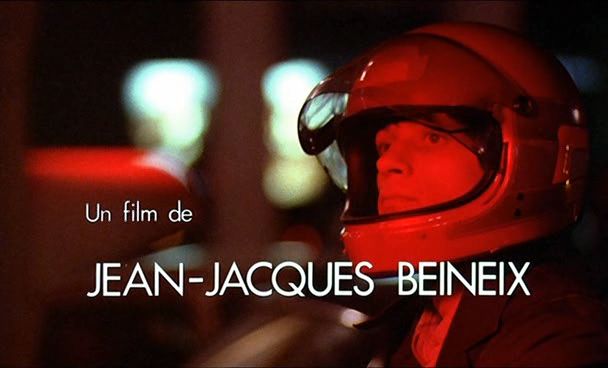
Screenshot from Diva, directed by Jean-Jacques Beineix
(Courtesy: www.servimg.com)
The movie Diva by director Jean-Jacques Beineix, was a mystery and a crime film that told the story of a mail carrier obsessed with an opera singer's voice. His obsession turned into a nightmare when one of his recordings of her becomes mistaken for a cassette that would incriminate the police chief on criminal charges.
I found the movie to be a little cheesy as the characters were doing things that seemed unrealistic or unnecessary. The scene where Nadia gets killed off in public seemed unrealistic as not many people reacted to it despite being in broad daylight, and in front of witnesses, two of whom were detectives.
Another scene that seemed unrealistic was when the detective was chasing Jules by car than on foot. Despite being a "track star" it is highly unlikely that the detective would've been able to keep up with Jules on his moped.
Despite these details, I thought that the movie was decent for a movie produced at its time. Preferably I would have liked more action or a more in depth story following the protagonist. The character of Gorodish was perhaps the best of all of them for his ominous background and witty thinking.
The recording device portrayed in the film was sophisticated technology at the time and was used to capture as well as feature the art of opera. The opera singer Cynthia Hawkins was reluctant to have her voice recorded, however, after the threat of bootlegging and meeting Jules, her stance changed to accommodate it. It was also the fact that she was in her 30's and her voice would not always be as it once swayed the change in decision. At the end it can be seen that the once stubborn "diva", embraced innovation and that her legacy would live on far past her existence without being tainted.
In the film it can be seen that the characters often use pay phones and radio transistors, now with mobile phones being so popular these products are now less commonly used. Overall, I saw a variety of uses for technology at the time and how it impacted many of the characters' decisions much like how our decisions are also influenced by modern technology.
Mike Tompkins' A Capella cover of Paradise by Coldplay
(Courtesy: www.tedeschi.mx)
The Youtube video by Mike Tompkins performing Paradise by Coldplay in A Capella was astounding. His voice is extremely versatile and is able to prove he can compose a song on his own. I have seen a few songs performed in A Capella, however, this is by far one of the more eye catching and involved out there. The addition of the multiple camera appearances definitely increases the engagement with viewers. With all of the sounds and movements his mouth makes, viewers can watch all of the effort that went into the making of the song.
The art of opera singing has evolved drastically since its creation in 16th century. Nowadays singers must reach and exceed new heights as they expand their talents far beyond just singing. Mike Tompkins displays this well as he demonstrates his skill beatboxing, singing and creatively imitating instruments as seen in his other videos. The singer of today seems to be well versed in a variety of fields, in addition to drawing inspiration from other talented artists. Even today's artists are somewhat of a technological genius. For someone whose main talent is singing, his videographer skills are impressive proving a true blend of technology and art in this modern age.
With the assistance of Youtube, millions of people are able to broadcast their talents and shared skills with the world. This expanded audience opens up many opportunities that they otherwise would not normally have. Many Youtube stars with a million or more followers started just like any other amateur user did when originally creating an account, with a minimal fanbase and a desire to reach thousands of viewers around the world. If opera in the 16th century had the ability to attract such a vast crowd for free, like Youtube has done for vocalists such as Mike Tompkins, then it would have been bigger in other countries than just Europe. Every culture has their own take on performance art and singing, yet all do not stem from opera itself, rather takes influences from each other and their traditional roots.
Overall, the modern day singers have evolved since Italian theatre and moved to an electronic stage than can be viewed by everyone at all times.